
Growing up disabled is not easy in a world that doesn’t recognize disabled people as valuable to society. In fact, depending on your experience it can be quite hard to find value in yourself, at all.
One of the ways that I was able to realize that I had worth was through other disabled people.
Often, these were disabled people that were older than me who had survived some of what I had. We don’t talk enough about how having disabled guides and older mentors can really combat a lot of the internalized ableism many of us experience.
I’ve been lucky enough to have multiple disabled people in my life across the years who did just that for me, and I wonder if I had not had any contact with disabled people how much worse my life would be.
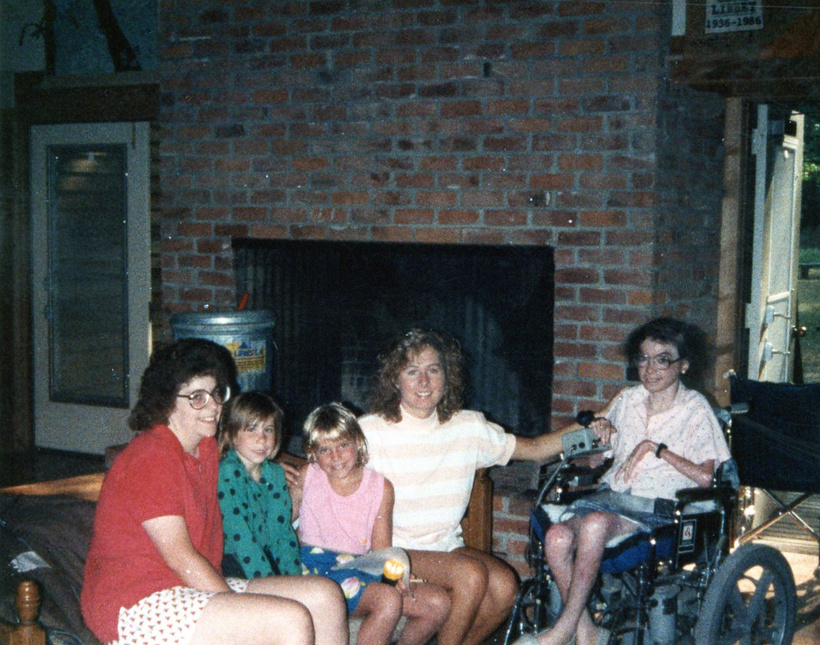
ID: photo of Dom, a small child wearing a green top with black polkadots, sits next to a child with shoulder length blonde hair and a pink tank top. There are three adults around them including an older woman, Nancy who is in an old power wheelchair. One of the other adult is touching Nancy’s shoulders.
I know that some disabled people are isolated with no contact with other disabled people, and they often have to experience a lot of what they go through alone. They also may not understand that they have a future because they’ve never seen another disabled person accomplish the things society says we can’t.
I’m six years old and at MDA camp. My counselor, a 16-year-old, tells me she can’t carry me because she has a bad back. Instead, she drags me along the ground. I have to keep stopping because I can only take so many steps and get tired.
The more I stop the more she harasses me. I can’t get my body to move and I’m too little to explain to her that she’s being hella ableist by yelling at me and trying to punish me for being unable to move.
Just then, an older gentleman with white hair pulls up in his small scooter. It’s Jack Howard. He is a legend in the Toledo area disability scene.
He and his wife have protested disability discrimination. They live in their own modified wheelchair accessible home. They run multiple businesses together including a jewelry store. They also do wheelchair van modifications. I know because they modified my van in 1994-ish.
I believe they may have even been associated or participated with ADAPT at one time, but I don’t know any of the details back in 1987. I don’t even know what ADAPT or independent living is.
Jack doesn’t address the counselor harming me. He doesn’t say anything to her at all. It’s a lesson I’ll have to learn – when we need to speak up and when we just need to take action. Jack was taking action.
Offering a ride on his lap, knowing my body couldn’t take any more physical activity, Jack would let me ride on his scooter throughout the entire week. He would do that for the next three years, as my family continued to insist that I did not need a wheelchair.
It’s 1988, and we are at a new camp – Camp Libbey in Defiance, Ohio. Previously we went to Camp DeSales in Michigan. I am a part of the girls cabin known as Juliet Low. I am one of the only little girls in the cabin. There are a handful of older girls – mostly teenagers.
There was Andrea, who has CMT. Her hair is brown and fluffy, and she’s from Michigan. She’s a preteen or teenager by the time I am seven. And she’s super cool. I want to be like her.
There is Nicky, who wore leg braces and always found everything we did hilarious. Very kind person and very fun to be around.
There was Brandi, only a few years older but inspiring a lot of us younger kids to go to college and have a life.
There was Christina, who has a scooter just like her dad, Jack Howard. She was a lesbian. I didn’t know it at the time, but she was pegging me as a queer little kid back in 1988 when she noticed my crush on another little girl.
Christina would reveal this at BGSU queer prom in the late 90s. She came as an alumni and I was a freshman. She was not at all surprised to see me at the queer prom! I however was shocked that people were reading me as queer from an early age. Mind Blown!
There was Nancy, who was an older woman with a power wheelchair who had a wicked sense of humor and you didn’t mess with her.
Eventually, there was Holly who I still know and talk to, who was devastated when MDA moved the camp age down so older teenagers and adults could no longer attend. She also has the same disability as me – SMA.
There was Lisa who deserved better because she understood everything that was going on but could not verbalize it. Lisa was also someone with SMA (type 1 unlike my type III). She deserved better from me.
Having older disabled people in my life made me recognize that I could and would have a future. These were the first disabled people that showed me I deserved to have a life.
I also got to see some of them as adults. We don’t get to see many disabled adults – not in the media, not in our personal lives. Seeing older disabled people growing up really countered the message that I wasn’t going to grow up or have a future.
Throughout the years I’ve had many other disabled mentors that were older and showed me the way toward independence for myself.
If you have a disabled child please make sure they have disabled mentors. They need someone that can truly help them navigate this amazingly ableist, intolerant world.
To all my mentors still around – thank you. You are a part of my story and a part of my life forever.
To those who have passed on – Jack, Christina, Stephanie (an older girl from my first year of camp who passed away a few years later), Lisa, Nancy…. You have helped make me the caring loving activist I am today.
May you forever rest in peace.
This was originally posted on Patreon In February 2024. Since then, we have lost many other mentors.
Comments