
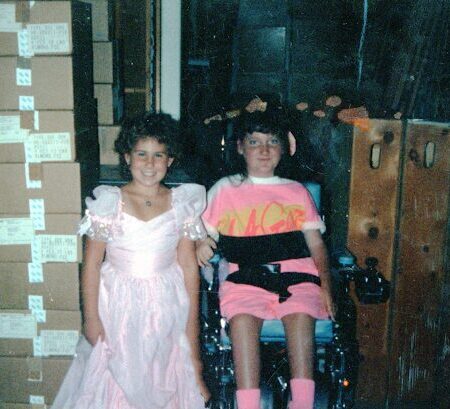
What is it about getting older that makes us reflect on the people who have passed on that had a significant influence on our life?
I’ve lost many people since I was very young, so I tend to do a lot of reflecting.
One of those friends was a camp friend who had known me since I was six years old. Two years older than me, she was like an older sister, and she did more than change my life, she saved it.
Brandi was born in the late 70s. I believe she had older sisters, but she was not raised with her parents. I was told that her parents didn’t want her, because she had SMA. I don’t know about the validity of that story, but I know that she was raised by the aunt and uncle of one of her parents.
They were amazing, loving, caring people. My abusive mother would often remind me that my life could be like Brandi’s. Personally, I find using her life story, which might not have even been accurate, as a tool to keep me in line deplorable, but what do I know? When I was at my most desperate, I was told, “don’t call CPS on us, because you’ll end up like Brandi.”
Like Brandi, I also have SMA. We were both diagnosed with Werdnig Hoffman, or Type 1. More likely, I have the more progressive form of Type 3 (3A), and Brandi was what we would call a weak Type 2. Types matter in terms of progression and understanding where the disability might go with it. I was ambulatory for much of my relationship with Brandi, and had only just become totally wheelchair dependent two years before she died.
Brandi’s aunt and uncle were lovely people. It’s funny that my mother would use that as a threat because I imagine having a loving aunt and uncle is better than having an abusive parent.
Despite not really understanding her situation, I do know that Brandi struggled with her relationship with her parents though. Whether they wanted her or not, I know she grappled with wanting to be wanted, and we did talk about that on the surface on more than one occasion.
Brandi was always very positive about everything and had that kind of outlook on it. She didn’t look at her situation as a glass half empty, but something half-full with love by the people that wanted to be around her. I wish I could have understood that much sooner.

A photo of three people at MDA Camp. Brandi sits in a wheelchair and another teenage girl, her her arm around her as they smile and pose for the camera. A third person stands to the side looking at a piece of paper.
Brandi had freedom and understanding of being disabled way before I did. Though she went to MDA camp and clinic, there was no pressure on her to conform to their standard or way of thinking about disability the way I and other youngsters experienced. She was the first to really understand that we deserved better treatment. I was still young and oblivious, when she was taking steps to secure her own freedom.
Brandi stopped being able to go to camp at 18. She stopped going a few years before that and I missed her because other than me, she was one of the few constant female campers close to my age. There were a few girls older than us, but it was lonely often being the youngest “girl” in the cabin without people like her to support me.
I also remember getting to hang out with her outside of camp a few times, and wishing we could do it more, but disability and getting around is not always easy, especially in places that have cruel winters, like Northwest, Ohio.
Brandi was one of the first of us to attend college. She was the first of us to show that we could go off to college on our own. It inspired me to live on campus at Bowling Green State University in 1999, when I first went to school. Most importantly it encouraged me to transfer to her alma mater, Wright State University, a school that I have many mixed feelings about because while I was abused there quite a bit, going there, with her in mind, saved my life.
In early 1999, when she was just shy of 20, Brandi died. She was able to attend one year of school before she passed away, but it was enough of a legacy to save not just my life, but inspire many others to go to Wright State from our camp.
During my first year at BG, I was outed to my on-campus PCAs/caregivers who quit. Unable to find reliable care, I was sent home where I had to go back to living with my abusive family. I knew that if I did not get away I would kill myself and it was then that I remembered where Brandi had gone and why.
In the late 90s/early 2000s, WSU was the premiere school for disabled, particularly wheelchair-using, students in Ohio. With southern Ohio a slightly milder climate than northern Ohio, the school provided a uniquely physically accessible campus.
It was like a physically disabled wheelchair user’s wonderland. There are underground tunnels connecting all of the buildings on campus, so you don’t have to go outside in inclement weather. The exception being some of the dorms, which were not connected.
It is also uniquely situated near Dayton, Ohio which is one of the most accessible cities for wheelchair users with its incredibly accessible bus system. Even back in the early 2000s the buses, while not super comfortable to ride on always had lifts and it was often easy to get around the city.
Additionally, back when I attended starting in 2000 until 2003 they had an unprecedented PCA program that they claim did not do many of the things that I know it did because I received services from them.
For example, they set us up with PCAs, who they claim they did not pay, but I know that I didn’t get any support from BVR (the Bureau of vocational rehabilitation) to pay for some of my caregivers, at least one of my semesters there, so who paid for them because I didn’t pay a cent?? Other friends have said the same thing although the school maintains that they were only the middlemen that set up the care. Still that was a significant support structure that most universities don’t have.
At the height of its inclusive efforts, many which no longer exist due to budget cuts, WSU offered PCA services that included an emergency pager on the weekend or anytime if you had a serious emergency, and on-campus bathroom with lifts getting people to help you go throughout the day even on the weekend, and a network of PCAs you could call if you needed someone new to work for you.
They offered alternatives for testing, extended time, alternative book formats (you would bring your books and they would turn them into whatever format needed), in class supports, readers and writers for those who could not move their hands or needed support for other reasons, people to help those eat on-campus so they did not miss meals, and various other stuff that I don’t even know about because I don’t have those needs.
While the staff was not always great, and many of us had major issues with disability services, as far as a physical campus could go this was one of the best. It provided many of us with the tools we needed to go on to be more independent. It certainly taught me that I did not have to live at home the rest of my life, something I was threatened with for many many years.
While I was home in early 2000 after having to leave my on-campus dorm at Bowling Green, I attempted to kill myself. The day after that was the day I applied to go to Wright State. Brandi was in my head and in my heart and she was telling me to get out of there and save myself.
It was Brandi who guided me to Wright State. It was Brandi who gave me the courage to apply and go through the process until I ended up attending that next fall. From March until September I had to survive and she kept me going, in my mind, reassuring me that I could do this, because she had done it, and if she could do it so could I.
One of the first friends I met at WSU was one of Brandi’s friends as well. I was able to share her legacy with others, and explain to them what she meant to me.
Having people in your life when you’re young and disabled who also understand what you are going through is imperative. Having mentors and big sisters like Brandi is a gift.
I was able to escape from home and never go back, and because of Brandi, here I am at 42 still living a strong independent life.

A group of people including Dom and Brandi posing for a photo in front of the community pool. Dom and Brandi are both in their wheelchairs. 8 other people pose behind them.
Brandi has been gone over 20 years now, but she is in my heart, in my work, and in everything I do. It is because of her that I try to be the mentor she was for me for other young wheelchair users. I try to teach them the lessons that she taught me.
We deserve to be as independent as we can be.
We deserve to live our lives.
We deserve whatever freedom we can gain. We are whole people, and we can and should follow our dreams.
I am thankful to Brandi for this, and I hope she knows her legacy continues through me.
I love you, Brandi. I hope your energy, wherever it is in the universe, knows I still care.
Comments